Brand Logo Moneyfacts Group plc
Telephone Icon T: 01603 476476 Email Icon E: enquiries@moneyfacts.co.uk LinkedIn Icon

Tax pressures and falling rates put savers on alert

Image of Moneyfacts.co.uk Brand Logo Image of Moneyfacts.co.uk Brand Logo Image of Moneyfacts.co.uk Brand Logo
Caitlyn Eastell, Apprentice Press & PR Assistant
Caitlyn Eastell, Press & PR Executive 01603 476169 Email Caitlyn
09/12/2025

Tax pressures and falling rates put savers on alert

An expected base rate cut and frozen tax thresholds threaten savers’ returns, so they should act quickly to protect their earnings. Moneyfactscompare.co.uk reveals the state of play in the fixed bond market for savers.

Tax pressures and falling rates put savers on alert

An expected base rate cut and frozen tax thresholds threaten savers’ returns, so they should act quickly to protect their earnings. Moneyfactscompare.co.uk reveals the state of play in the fixed bond market for savers.

Top fixed bonds

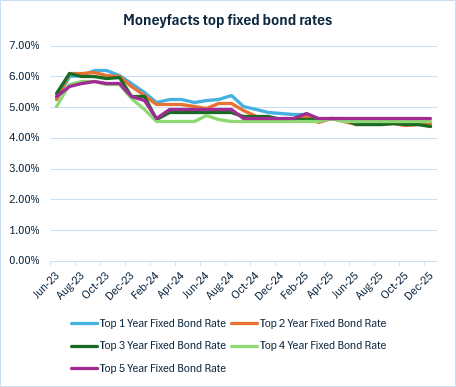
  • The top one-year bond rose, while the top three-year fell, and the top two-, four- and five-year bonds remained unchanged.
  • The top one-year fixed bond rose to 4.50% gross, which is 0.14% lower than the top five-year fixed bond at 4.64%. The top five-year bond rate was higher than the top one-year bond a month prior by 0.18%.
  • In June 2025, the top one-year bond paid 4.45% and the top five-year paid 4.64%.
  • A year ago, the top one-year bond paid 4.80%, while the top five-year bond paid 4.64%, a gap of 0.16%.
  • The impacts of fiscal drag could push millions of taxpayers into the higher-rate band, subsequently halving their Personal Savings Allowance (PSA), higher-rate payers with around £14,500 and earning 3.40%, are at risk of breaching their £500 allowance. Savers should consider the benefits of a cash ISA. The top one-year cash ISA pays 4.30%, those maxing out their ISA limits will receive £860 which is protected in an ISA, but in its fixed bond counterpart it would breach the £500 PSA

Top fixed bonds

  • The top one-year bond rose, while the top three-year fell, and the top two-, four- and five-year bonds remained unchanged.
  • The top one-year fixed bond rose to 4.50% gross, which is 0.14% lower than the top five-year fixed bond at 4.64%. The top five-year bond rate was higher than the top one-year bond a month prior by 0.18%.
  • In June 2025, the top one-year bond paid 4.45% and the top five-year paid 4.64%.
  • A year ago, the top one-year bond paid 4.80%, while the top five-year bond paid 4.64%, a gap of 0.16%.
  • The impacts of fiscal drag could push millions of taxpayers into the higher-rate band, subsequently halving their Personal Savings Allowance (PSA), higher-rate payers with around £14,500 and earning 3.40%, are at risk of breaching their £500 allowance. Savers should consider the benefits of a cash ISA. The top one-year cash ISA pays 4.30%, those maxing out their ISA limits will receive £860 which is protected in an ISA, but in its fixed bond counterpart it would breach the £500 PSA


Savings market analysis – top fixed bond rates


Jun-23

Dec-23

Jun-24

Dec-24

Jun-25

Nov-25

Dec-25

Top one-year fixed bond rate

5.25%

5.80%

5.22%

4.80%

4.45%

4.46%

4.50%

Top two-year fixed bond rate

5.28%

5.70%

4.96%

4.60%

4.44%

4.45%

4.45%

Top three-year fixed bond rate

5.45%

5.35%

4.85%

4.61%

4.45%

4.44%

4.39%

Top four-year fixed bond rate

5.05%

5.30%

4.75%

4.54%

4.54%

4.54%

4.54%

Top five-year fixed bond rate

5.35%

5.35%

4.95%

4.64%

4.64%

4.64%

4.64%

Top interest rates based on a £10,000 deposit as at the start of the month.

Source: Moneyfactscompare.co.uk


Average fixed bonds

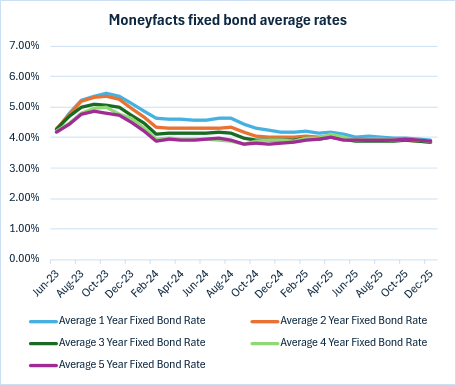
  • The average one-year fixed bond rate at 3.92% gross is now 0.04% higher than the average five-year fixed bond at 3.88%. The rate gap was 0.02% a month prior.
  • In June 2025, the rate gap between the average one- and five-year bonds was 0.11%, as they sat at 4.02% and 3.91%, respectively.
  • A year ago, the average one-year bond paid 4.19%, while the average five-year bond paid 3.83%, a rate gap of 0.36%.


Savings market analysis – average fixed bond rates


Jun-23

Dec-23

Jun-24

Dec-24

Jun-25

Nov-25

Dec-25

Average one-year fixed bond rate

4.21%

5.14%

4.58%

4.19%

4.02%

3.95%

3.92%

Average two-year fixed bond rate

4.26%

4.97%

4.30%

4.00%

3.94%

3.89%

3.85%

Average three-year fixed bond rate

4.28%

4.72%

4.13%

3.90%

3.89%

3.87%

3.84%

Average four-year fixed bond rate

4.20%

4.64%

3.94%

3.91%

3.93%

3.92%

3.89%

Average five-year fixed bond rate

4.19%

4.50%

3.95%

3.83%

3.91%

3.93%

3.88%

Average interest rates based on a £10,000 deposit as at the start of the month.

Source: Moneyfactscompare.co.uk


Savings market analysis – top fixed bond rates


Jun-23

Dec-23

Jun-24

Dec-24

Jun-25

Nov-25

Dec-25

Top one-year fixed bond rate

5.25%

5.80%

5.22%

4.80%

4.45%

4.46%

4.50%

Top two-year fixed bond rate

5.28%

5.70%

4.96%

4.60%

4.44%

4.45%

4.45%

Top three-year fixed bond rate

5.45%

5.35%

4.85%

4.61%

4.45%

4.44%

4.39%

Top four-year fixed bond rate

5.05%

5.30%

4.75%

4.54%

4.54%

4.54%

4.54%

Top five-year fixed bond rate

5.35%

5.35%

4.95%

4.64%

4.64%

4.64%

4.64%

Top interest rates based on a £10,000 deposit as at the start of the month.

Source: Moneyfactscompare.co.uk


Average fixed bonds

  • The average one-year fixed bond rate at 3.92% gross is now 0.04% higher than the average five-year fixed bond at 3.88%. The rate gap was 0.02% a month prior.
  • In June 2025, the rate gap between the average one- and five-year bonds was 0.11%, as they sat at 4.02% and 3.91%, respectively.
  • A year ago, the average one-year bond paid 4.19%, while the average five-year bond paid 3.83%, a rate gap of 0.36%.


Savings market analysis – average fixed bond rates


Jun-23

Dec-23

Jun-24

Dec-24

Jun-25

Nov-25

Dec-25

Average one-year fixed bond rate

4.21%

5.14%

4.58%

4.19%

4.02%

3.95%

3.92%

Average two-year fixed bond rate

4.26%

4.97%

4.30%

4.00%

3.94%

3.89%

3.85%

Average three-year fixed bond rate

4.28%

4.72%

4.13%

3.90%

3.89%

3.87%

3.84%

Average four-year fixed bond rate

4.20%

4.64%

3.94%

3.91%

3.93%

3.92%

3.89%

Average five-year fixed bond rate

4.19%

4.50%

3.95%

3.83%

3.91%

3.93%

3.88%

Average interest rates based on a £10,000 deposit as at the start of the month.

Source: Moneyfactscompare.co.uk


Caitlyn Eastell, Spokesperson at Moneyfactscompare.co.uk, said:

“This year the top fixed bonds have been consistently paying above 4%, however, with the likelihood of a December base rate cut growing, this may not be the case for much longer. In November 2023 the most competitive rates were paying around 6%, but harsh cuts meant that by December rates had tumbled. Savers should try their best to be reactive as there is a cost to waiting; during this time, hesitant savers who put £10,000 in a one-year bond would’ve missed out on £25. While in today’s terms the difference is less stark, it reinforces the importance of securing the most attractive deals to avoid missing out.

“Over the next few years millions of savers will be hit hard by fiscal drag as basic-rate payers move up to higher income tax brackets now that the thresholds are frozen until 2031. As a result, their Personal Savings Allowance (PSA) will halve. With inflation still running above target, plus potentially footing an unexpected tax bill, this may mean that savers’ nest eggs could rapidly be losing ‘real’ returns. While fixed bonds typically pay higher rates, they don’t provide the same tax benefits as cash ISAs. On average, savers paying the higher-rate only have a £500 PSA, meaning those with around £14,500 in their savings may wish to consider switching to an ISA to ensure their whole balance is protected as they currently have a £20,000 tax-free allowance. Cash ISAs are popular among many savers, with the latest Money and Credit Stats from the Bank of England revealing that an extra £4.2 billion was deposited into cash ISAs during October. This acted like a second ISA wave amid the now confirmed tax-free allowance cut.”


Caitlyn Eastell, Spokesperson at Moneyfactscompare.co.uk, said:

“This year the top fixed bonds have been consistently paying above 4%, however, with the likelihood of a December base rate cut growing, this may not be the case for much longer. In November 2023 the most competitive rates were paying around 6%, but harsh cuts meant that by December rates had tumbled. Savers should try their best to be reactive as there is a cost to waiting; during this time, hesitant savers who put £10,000 in a one-year bond would’ve missed out on £25. While in today’s terms the difference is less stark, it reinforces the importance of securing the most attractive deals to avoid missing out.

“Over the next few years millions of savers will be hit hard by fiscal drag as basic-rate payers move up to higher income tax brackets now that the thresholds are frozen until 2031. As a result, their Personal Savings Allowance (PSA) will halve. With inflation still running above target, plus potentially footing an unexpected tax bill, this may mean that savers’ nest eggs could rapidly be losing ‘real’ returns. While fixed bonds typically pay higher rates, they don’t provide the same tax benefits as cash ISAs. On average, savers paying the higher-rate only have a £500 PSA, meaning those with around £14,500 in their savings may wish to consider switching to an ISA to ensure their whole balance is protected as they currently have a £20,000 tax-free allowance. Cash ISAs are popular among many savers, with the latest Money and Credit Stats from the Bank of England revealing that an extra £4.2 billion was deposited into cash ISAs during October. This acted like a second ISA wave amid the now confirmed tax-free allowance cut.”


Notes to editors

You are welcome to use part or all of this press release, so long as we are sufficiently sourced. We would appreciate a link back to Moneyfactscompare.co.uk.

Pioneering financial comparison technology for over 35 years, Moneyfacts Group plc is the UK’s leading provider of retail financial product data. Used by virtually every bank and building society in the UK, and supplied to the Bank of England, Financial Conduct Authority, Financial Ombudsman Service, HM Treasury, Prudential Regulatory Authority and UK Finance.

Our expert research team monitors the thousands of mortgages, savings, credit card, personal loan, banking, life, pension and investment products in the UK.

Moneyfactscompare.co.uk is the financial product price comparison site, launched as Moneyfacts.co.uk in 2000 and rebranded to Moneyfactscompare.co.uk in 2023, which helps consumers compare thousands of financial products, including credit cards, savings, mortgages and many more. Unlike other comparison sites, Moneyfactscompare.co.uk shows whole of market data regardless of commercial bias, showing consumers a true picture of the best products based on the criteria they select.

For more information about us please see our key facts.

Broadcast

Our broadcast suite enables our finance experts to appear in-vision for television, and we regularly comment live on national and regional radio.

To arrange an interview for radio or television, please contact our press department. We have an in-house broadcast room.


 

Notes to editors

You are welcome to use part or all of this press release, so long as we are sufficiently sourced. We would appreciate a link back to Moneyfactscompare.co.uk.

Pioneering financial comparison technology for over 35 years, Moneyfacts Group plc is the UK’s leading provider of retail financial product data. Used by virtually every bank and building society in the UK, and supplied to the Bank of England, Financial Conduct Authority, Financial Ombudsman Service, HM Treasury, Prudential Regulatory Authority and UK Finance.

Our expert research team monitors the thousands of mortgages, savings, credit card, personal loan, banking, life, pension and investment products in the UK.

Moneyfactscompare.co.uk is the financial product price comparison site, launched as Moneyfacts.co.uk in 2000 and rebranded to Moneyfactscompare.co.uk in 2023, which helps consumers compare thousands of financial products, including credit cards, savings, mortgages and many more. Unlike other comparison sites, Moneyfactscompare.co.uk shows whole of market data regardless of commercial bias, showing consumers a true picture of the best products based on the criteria they select.

For more information about us please see our key facts.

Broadcast

Our broadcast suite enables our finance experts to appear in-vision for television, and we regularly comment live on national and regional radio.

To arrange an interview for radio or television, please contact our press department. We have an in-house broadcast room.

 

Contact Us If you're looking for extra comment, a chart or more information, then please give us a call. We are always more than happy to help.
Adam French Head of News & Communications
Rachel Springall Press Officer / Finance Expert
Caitlyn Eastell Press & PR Executive