Brand Logo Moneyfacts Group plc
Telephone Icon T: 01603 476476 Email Icon E: enquiries@moneyfacts.co.uk LinkedIn Icon

Mortgage lifespan falls to record low as choice shrinks

Image of a Moneyfacts Mortgage Treasury Report Image of a Moneyfacts Mortgage Treasury Report Image of a Moneyfacts Mortgage Treasury Report
Rachel Springall, Press Officer
Rachel Springall, Finance Expert 01603 476210 Email Rachel
13/04/2026

Mortgage lifespan falls to record low as choice shrinks 

Moneyfacts UK Mortgage Trends Treasury Report data reveals the average shelf-life of a mortgage has fallen to a record-low, product choice has shrunk to a two-year low and fixed mortgage rates rose by notable margins.


Mortgage lifespan falls to record low as choice shrinks 

Moneyfacts UK Mortgage Trends Treasury Report data reveals the average shelf-life of a mortgage has fallen to a record-low, product choice has shrunk to a two-year low and fixed mortgage rates rose by notable margins.


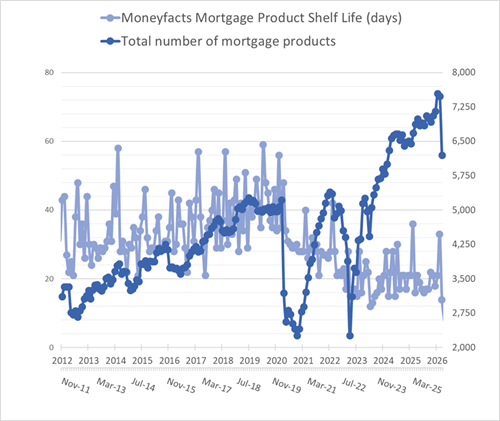
  • Mortgage activity during March hit the average shelf-life of a mortgage, down to a record low of just eight days (records began in November 2011), down from 14 days for February. The previous lowest average lifespan of a mortgage was in July 2023, at just 12 days. The average shelf-life is now lower than what it was at the start of October 2022 (15 days), when the ‘mini-Budget’ had an unprecedented impact on mortgage choice.
  • Overall product choice shrank month-on-month, down by 1,283 options, falling below 7,000 options for the first time since November 2025. The current pool of 6,201 options is at its lowest count in two years (March 2024 – 6,004). Lenders pulled products from sale in March 2026 due to uncertainty over the future path of interest rates.
  • The Moneyfacts UK Mortgage Trends Treasury Report captures first of month data, and since the start of March, the average two-year fixed rate increased by 1%, the biggest monthly rise since November 2022 (up by 1.04%), and the average five-year rose by 0.79%, the biggest monthly rise since July 2023 (up by 0.80%).
  • Fixed rates are still much lower than the average ‘revert to’ rate or Standard Variable Rate (SVR). The average SVR remains at 7.13% month-on-month, down by 0.47% year-on-year from 7.60%. The highest recorded was 8.19% during November and December 2023.
  • Mortgage activity during March hit the average shelf-life of a mortgage, down to a record low of just eight days (records began in November 2011), down from 14 days for February. The previous lowest average lifespan of a mortgage was in July 2023, at just 12 days. The average shelf-life is now lower than what it was at the start of October 2022 (15 days), when the ‘mini-Budget’ had an unprecedented impact on mortgage choice.
  • Overall product choice shrank month-on-month, down by 1,283 options, falling below 7,000 options for the first time since November 2025. The current pool of 6,201 options is at its lowest count in two years (March 2024 – 6,004). Lenders pulled products from sale in March 2026 due to uncertainty over the future path of interest rates.
  • The Moneyfacts UK Mortgage Trends Treasury Report captures first of month data, and since the start of March, the average two-year fixed rate increased by 1%, the biggest monthly rise since November 2022 (up by 1.04%), and the average five-year rose by 0.79%, the biggest monthly rise since July 2023 (up by 0.80%).
  • Fixed rates are still much lower than the average ‘revert to’ rate or Standard Variable Rate (SVR). The average SVR remains at 7.13% month-on-month, down by 0.47% year-on-year from 7.60%. The highest recorded was 8.19% during November and December 2023.

Rachel Springall, Finance Expert at Moneyfacts, said:

“The lifespan of a mortgage deal has plummeted to a record low of just eight days on average and mortgage product availability has shrunk by around 17% in just one month. Fixed mortgage rates noted sizeable marginal increases month-on-month, such as with the average two-year fixed rate rising by 1% for the first time in nearly four years, way back in November 2022. The unrest in the Middle East caused mortgage mayhem, with lenders rushing to pull products from sale and reprice at higher rates throughout March. Unfortunately, this has led to a drop of almost 400 options for borrowers with just a 5% or 10% deposit or equity, awful news for first-time buyers. The market overall has experienced the worst upheaval to mortgage choice since the mini-Budget, yet another blow for borrowers over the past five years, which includes the surge in interest rates during the summer of 2023 amid higher inflation expectations.

“Concerns surrounding the possibility of inflation getting out of control this year has completely flipped the projected path of interest rates. The start of 2026 appeared promising, especially for borrowers about to remortgage, but it’s all changed. The tide could turn once the markets feel more confident about future rate pricing, but borrowers who are due to come off a deal soon will be incredibly frustrated by mortgage rate hikes. If someone took out a typical mortgage now, compared to the start of March, it would cost them around £1,800 a year more in repayments on a two-year fixed deal*. Worse still, borrowing the same size loan on a typical mortgage now, compared to 2021 on a five-year fixed deal, would cost around £5,000 more in mortgage repayments over one year.

“It will be essential for borrowers to keep calm and seek advice from a broker to navigate the mortgage maze. Brokers are an anchor during times of turbulence as they can help borrowers understand how they can best afford a mortgage or plan the available options months in advance. Borrowers could try to overpay their mortgage, as paying just £100 more per month can shave almost three years off their loan and save over £25,000 in interest on a typical mortgage charging 5%.”

*Typical mortgage based on a loan of £250,000 over 25 years, two-year fixed rate in March 2026 of 4.84% versus April 2026 of 5.84%, other calculations based on a five-year fixed average of 2.77% in April 2021 versus 5.75% in April 2026.


Rachel Springall, Finance Expert at Moneyfacts, said:

“The lifespan of a mortgage deal has plummeted to a record low of just eight days on average and mortgage product availability has shrunk by around 17% in just one month. Fixed mortgage rates noted sizeable marginal increases month-on-month, such as with the average two-year fixed rate rising by 1% for the first time in nearly four years, way back in November 2022. The unrest in the Middle East caused mortgage mayhem, with lenders rushing to pull products from sale and reprice at higher rates throughout March. Unfortunately, this has led to a drop of almost 400 options for borrowers with just a 5% or 10% deposit or equity, awful news for first-time buyers. The market overall has experienced the worst upheaval to mortgage choice since the mini-Budget, yet another blow for borrowers over the past five years, which includes the surge in interest rates during the summer of 2023 amid higher inflation expectations.

“Concerns surrounding the possibility of inflation getting out of control this year has completely flipped the projected path of interest rates. The start of 2026 appeared promising, especially for borrowers about to remortgage, but it’s all changed. The tide could turn once the markets feel more confident about future rate pricing, but borrowers who are due to come off a deal soon will be incredibly frustrated by mortgage rate hikes. If someone took out a typical mortgage now, compared to the start of March, it would cost them around £1,800 a year more in repayments on a two-year fixed deal*. Worse still, borrowing the same size loan on a typical mortgage now, compared to 2021 on a five-year fixed deal, would cost around £5,000 more in mortgage repayments over one year.

“It will be essential for borrowers to keep calm and seek advice from a broker to navigate the mortgage maze. Brokers are an anchor during times of turbulence as they can help borrowers understand how they can best afford a mortgage or plan the available options months in advance. Borrowers could try to overpay their mortgage, as paying just £100 more per month can shave almost three years off their loan and save over £25,000 in interest on a typical mortgage charging 5%.”

*Typical mortgage based on a loan of £250,000 over 25 years, two-year fixed rate in March 2026 of 4.84% versus April 2026 of 5.84%, other calculations based on a five-year fixed average of 2.77% in April 2021 versus 5.75% in April 2026.

 

Mortgage market analysis


Apr-24

Apr-25

Oct-25

Mar-26

Apr-26

Fixed and variable rate products

Total product count - all LTVs

6,307

6,870

6,998

7,484

6,201

Product count - 95% LTV

335

442

453

541

368

Product count - 90% LTV

774

845

909

979

759

Product count - 60% LTV

723

797

790

820

739

All products

Shelf-life (days)

22

21

22

14

8

All LTVs

Average two-year fixed rate

5.80%

5.32%

4.98%

4.84%

5.84%

Average five-year fixed rate

5.39%

5.18%

5.02%

4.96%

5.75%

95% LTV

Average two-year fixed rate

6.03%

5.81%

5.46%

5.45%

6.40%

Average five-year fixed rate

5.53%

5.62%

5.44%

5.47%

6.18%

90% LTV

Average two-year fixed rate

6.04%

5.59%

5.27%

5.08%

6.12%

Average five-year fixed rate

5.49%

5.33%

5.18%

5.12%

5.98%

60% LTV

Average two-year fixed rate

5.29%

4.79%

4.52%

4.23%

5.39%

Average five-year fixed rate

4.95%

4.69%

4.68%

4.56%

5.43%

All LTVs

Standard Variable Rate (SVR)

8.18

7.60

7.27

7.13

7.13

All LTVs

Average two-year tracker rate

6.14

5.20

4.67

4.43

4.69

Data shown is as at the first available day of the month, unless stated otherwise.

Source: Moneyfacts Treasury Reports


Moneyfacts Average Mortgage Rate


Apr-24

Apr-25

Oct-25

Mar-26

Apr-26

Moneyfacts Average
Mortgage Rate

5.65%

5.28%

5.01%

4.90%

5.72%

Calculated from the total of all on-sale, core market, fixed and variable tracker mortgages. Standard exclusions apply: Self-build only, shared ownership only, new build only, shared equity only, standard variable rates and adverse credit

Source: Moneyfacts Average Mortgage Rate.


Mortgage market analysis


Apr-24

Apr-25

Oct-25

Mar-26

Apr-26

Fixed and variable rate products

Total product count - all LTVs

6,307

6,870

6,998

7,484

6,201

Product count - 95% LTV

335

442

453

541

368

Product count - 90% LTV

774

845

909

979

759

Product count - 60% LTV

723

797

790

820

739

All products

Shelf-life (days)

22

21

22

14

8

All LTVs

Average two-year fixed rate

5.80%

5.32%

4.98%

4.84%

5.84%

Average five-year fixed rate

5.39%

5.18%

5.02%

4.96%

5.75%

95% LTV

Average two-year fixed rate

6.03%

5.81%

5.46%

5.45%

6.40%

Average five-year fixed rate

5.53%

5.62%

5.44%

5.47%

6.18%

90% LTV

Average two-year fixed rate

6.04%

5.59%

5.27%

5.08%

6.12%

Average five-year fixed rate

5.49%

5.33%

5.18%

5.12%

5.98%

60% LTV

Average two-year fixed rate

5.29%

4.79%

4.52%

4.23%

5.39%

Average five-year fixed rate

4.95%

4.69%

4.68%

4.56%

5.43%

All LTVs

Standard Variable Rate (SVR)

8.18

7.60

7.27

7.13

7.13

All LTVs

Average two-year tracker rate

6.14

5.20

4.67

4.43

4.69

Data shown is as at the first available day of the month, unless stated otherwise.

Source: Moneyfacts Treasury Reports


Moneyfacts Average Mortgage Rate


Apr-24

Apr-25

Oct-25

Mar-26

Apr-26

Moneyfacts Average
Mortgage Rate

5.65%

5.28%

5.01%

4.90%

5.72%

Calculated from the total of all on-sale, core market, fixed and variable tracker mortgages. Standard exclusions apply: Self-build only, shared ownership only, new build only, shared equity only, standard variable rates and adverse credit

Source: Moneyfacts Average Mortgage Rate.


Notes to editors

You are welcome to use part or all of this press release, so long as we are sufficiently sourced. We would appreciate a link back to Moneyfactsgroup.co.uk.

Pioneering financial comparison technology for over 35 years, Moneyfacts Group plc is the UK’s leading provider of retail financial product data. Used by virtually every bank and building society in the UK, and supplied to the Bank of England, Financial Conduct Authority, Financial Ombudsman Service, HM Treasury, Prudential Regulatory Authority and UK Finance.

Our expert research team monitors the thousands of mortgages, savings, credit card, personal loan, banking, life, pension and investment products in the UK.

For more information about us please see our key facts.

Broadcast

Our broadcast suite enables our finance experts to appear in-vision for television, and we regularly comment live on national and regional radio.

To arrange an interview for radio or television, please contact our press department. We have an in-house broadcast room.


Notes to editors

You are welcome to use part or all of this press release, so long as we are sufficiently sourced. We would appreciate a link back to Moneyfactsgroup.co.uk.

Pioneering financial comparison technology for over 35 years, Moneyfacts Group plc is the UK’s leading provider of retail financial product data. Used by virtually every bank and building society in the UK, and supplied to the Bank of England, Financial Conduct Authority, Financial Ombudsman Service, HM Treasury, Prudential Regulatory Authority and UK Finance.

Our expert research team monitors the thousands of mortgages, savings, credit card, personal loan, banking, life, pension and investment products in the UK.

For more information about us please see our key facts.

Broadcast

Our broadcast suite enables our finance experts to appear in-vision for television, and we regularly comment live on national and regional radio.

To arrange an interview for radio or television, please contact our press department. We have an in-house broadcast room.


Contact Us If you're looking for extra comment, a chart or more information, then please give us a call. We are always more than happy to help.
Adam French Head of Consumer Finance
Rachel Springall Finance Expert
Caitlyn Eastell Personal Finance Analyst