Brand Logo Moneyfacts Group plc
Telephone Icon T: 01603 476476 Email Icon E: enquiries@moneyfacts.co.uk LinkedIn Icon

What will mortgage and savings rates be in 2026?

Image of Moneyfacts.co.uk Brand Logo Image of Moneyfacts.co.uk Brand Logo Image of Moneyfacts.co.uk Brand Logo
Adam French, Head of News & Communications 01603 476154 Email Adam
19/12/2025

What will mortgage and savings rates be in 2026?

It has been a year of gradual change. Borrowers are benefiting from easing mortgage costs and wider choice, but affordability pressures remain for those refinancing from much cheaper deals. Savers, meanwhile, have been seeing real returns erode despite inflation appearing to ease.

What is clear is that while interest rates are heading lower, they are not returning to the ultra-low levels of the recent past. Instead, 2026 may be the year the UK fully adjusts to a higher rate for both borrowing and saving.

What will mortgage and savings rates be in 2026?

It has been a year of gradual change. Borrowers are benefiting from easing mortgage costs and wider choice, but affordability pressures remain for those refinancing from much cheaper deals. Savers, meanwhile, have been seeing real returns erode despite inflation appearing to ease.

What is clear is that while interest rates are heading lower, they are not returning to the ultra-low levels of the recent past. Instead, 2026 may be the year the UK fully adjusts to a higher rate for both borrowing and saving.

Residential mortgage rates in 2025

  • Residential mortgage rates eased steadily through 2025, with two-year fixes falling from 5.46% to 4.93% and five-year fixes from 5.26% to 4.98%.
  • Standard Variable Rates also declined but remained high, ending the year above 7.25%, reinforcing the incentive to fix rather than stay on an SVR.
  • A typical borrower taking out a fixed rate mortgage at the end of 2025 compared to the start of the year will be £25 per month (£300 per year) better off for every £100k borrowed over 25 years.
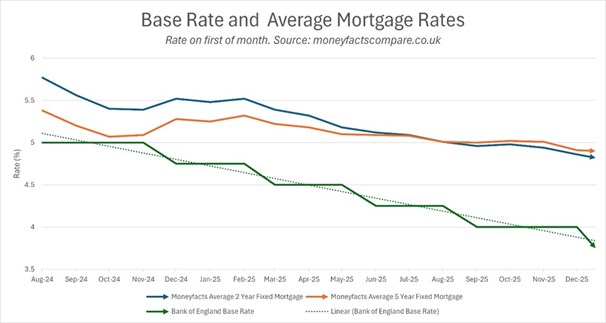
  • However, average mortgage rates have not fallen to the same extent as the Bank of England Base Rate, which has fallen by a full percentage point over the last 12 months.


  2-yr fix 5-yr fix Overall

2025

Average rate

Average rate

Average Standard Variable Rate (SVR)

Moneyfacts Average Mortgage Rate

Jan - Mar

5.46

5.26

7.76

5.39

Apr - Jun

5.21

5.12

7.55

5.19

Jul - Sep

5.02

5.03

7.39

5.05

Oct - Dec

4.93

4.98

7.27

4.97

Source: Moneyfacts. Average of first of month figures for each quarter


Savings rates (savings accounts and cash ISAs) in 2025

  • Savers fared less well, with typical easy-access rates falling from 2.90% to 2.53% and one-year fixed rates dropping below 4%.
  • A saver with £10,000 saved in a typical account will earn £24 less interest at the end of 2025 compared to the start of the year.


2025

Easy Access

1-yr fixed

Easy access cash ISA

1-yr fix cash ISA

Overall Moneyfacts Average Saving rate

Jan - Mar

2.90

4.19

3.05

4.08

3.66

Apr - Jun

2.76

4.11

3.02

4.03

3.58

Jul - Sep

2.65

4.01

2.90

3.94

3.49

Oct - Dec

2.53

3.95

2.72

3.88

3.42

Source: Moneyfacts. Average of first of month figures for each quarter


Residential mortgage rates in 2025

  • Residential mortgage rates eased steadily through 2025, with two-year fixes falling from 5.46% to 4.93% and five-year fixes from 5.26% to 4.98%.
  • Standard Variable Rates also declined but remained high, ending the year above 7.25%, reinforcing the incentive to fix rather than stay on an SVR.
  • A typical borrower taking out a fixed rate mortgage at the end of 2025 compared to the start of the year will be £25 per month (£300 per year) better off for every £100k borrowed over 25 years.
  • However, average mortgage rates have not fallen to the same extent as the Bank of England Base Rate, which has fallen by a full percentage point over the last 12 months.


  2-yr fix 5-yr fix Overall

2025

Average rate

Average rate

Average Standard Variable Rate (SVR)

Moneyfacts Average Mortgage Rate

Jan - Mar

5.46

5.26

7.76

5.39

Apr - Jun

5.21

5.12

7.55

5.19

Jul - Sep

5.02

5.03

7.39

5.05

Oct - Dec

4.93

4.98

7.27

4.97

Source: Moneyfacts. Average of first of month figures for each quarter


Savings rates (savings accounts and cash ISAs) in 2025

  • Savers fared less well, with typical easy-access rates falling from 2.90% to 2.53% and one-year fixed rates dropping below 4%.
  • A saver with £10,000 saved in a typical account will earn £24 less interest at the end of 2025 compared to the start of the year.


2025

Easy Access

1-yr fixed

Easy access cash ISA

1-yr fix cash ISA

Overall Moneyfacts Average Saving rate

Jan - Mar

2.90

4.19

3.05

4.08

3.66

Apr - Jun

2.76

4.11

3.02

4.03

3.58

Jul - Sep

2.65

4.01

2.90

3.94

3.49

Oct - Dec

2.53

3.95

2.72

3.88

3.42

Source: Moneyfacts. Average of first of month figures for each quarter


What rates can borrowers and savers expect in 2026?

A Base Rate around 3.5% in 2026 may signal a return to a more “neutral” rate environment but benefits for households may be uneven.  While easing pressure on borrowers, meaningful returns for savers may become more elusive.


Mortgages

  • The Bank of England governor’s comments suggesting that any further cuts next year are more in the balance could lead to more caution from lenders.
  • Mortgage rates have typically tracked around 0.8 percentage points above the Base Rate, suggesting average mortgage rates of 4-4.5% in a 3-3.5% Base Rate environment.
  • If the Moneyfacts Average Mortgage Rate reaches 4.3% in 2026 a typical borrower taking out a fixed rate mortgage will be around £38 per month (£456 per year) better off for every £100k borrowed over 25 years, compared to today.


Savings

  • Savings rates have lagged the Base Rate by about one percentage point since 2023, implying average savings rates of roughly 2.5% if the Base Rate settles at 3.5%.
  • Even if inflation reaches the Bank of England’s 2% target, many savers will struggle to achieve meaningful real returns on cash.


Adam French, Head of News at Moneyfactscompare.co.uk, said:

“If the Bank of England Base Rate settles around 3.5% in 2026, as current forecasts suggest, that may represent a more ‘neutral’ interest rate environment. However, what it means for households is varied.

“Mortgage borrowers may see more tangible savings, but expectations should remain measured. Over the past few years, average mortgage rates have typically sat around 0.8 percentage points above the Base Rate. On that basis, a 3-3.5% Base Rate suggests average mortgage rates settling between 4% and 4.5%, lower than today, but still substantially higher than the ultra-cheap borrowing many households became accustomed to in the 2010s.

“There are signs that uncertainty has eased since the Budget, and markets expect a further Base Rate cut to feed through into mortgage pricing. However, the outlook remains finely balanced. The effects of the budget and disinflationary pressure from China may help contain prices, but global volatility, weak growth and persistent services inflation mean the road ahead may yet have a few more bumps in store.

“The timing is important too. Around 1.8 million fixed-rate mortgages are due to expire in 2026 according to UK Finance, many taken out at historically low rates. As these borrowers refinance, significantly higher repayments will follow, and the adjustment is far from over for many households.

“Since the start of 2023, average savings rates have consistently trailed the Base Rate by around one percentage point. If that relationship holds, a 3.5% Base Rate would translate into average savings rates of roughly 2.5%. Even if inflation returns to the Bank’s 2% target, many savers will still struggle to achieve meaningful real returns, leaving their cash effectively standing still.

“If inflation proves stickier than hoped, low real returns may mean household savings are effectively subsidising cheaper borrowing elsewhere in the economy. For all the talk about lower rates easing pressure on households, perhaps the most comprehensive way to put money back into more people’s pockets is to stop prices rising so fast, and it risks being at odds with the ongoing desire to cut rates.”


What rates can borrowers and savers expect in 2026?

A Base Rate around 3.5% in 2026 may signal a return to a more “neutral” rate environment but benefits for households may be uneven.  While easing pressure on borrowers, meaningful returns for savers may become more elusive.


Mortgages

  • The Bank of England governor’s comments suggesting that any further cuts next year are more in the balance could lead to more caution from lenders.
  • Mortgage rates have typically tracked around 0.8 percentage points above the Base Rate, suggesting average mortgage rates of 4-4.5% in a 3-3.5% Base Rate environment.
  • If the Moneyfacts Average Mortgage Rate reaches 4.3% in 2026 a typical borrower taking out a fixed rate mortgage will be around £38 per month (£456 per year) better off for every £100k borrowed over 25 years, compared to today.


Savings

  • Savings rates have lagged the Base Rate by about one percentage point since 2023, implying average savings rates of roughly 2.5% if the Base Rate settles at 3.5%.
  • Even if inflation reaches the Bank of England’s 2% target, many savers will struggle to achieve meaningful real returns on cash.


Adam French, Head of News at Moneyfactscompare.co.uk, said:

“If the Bank of England Base Rate settles around 3.5% in 2026, as current forecasts suggest, that may represent a more ‘neutral’ interest rate environment. However, what it means for households is varied.

“Mortgage borrowers may see more tangible savings, but expectations should remain measured. Over the past few years, average mortgage rates have typically sat around 0.8 percentage points above the Base Rate. On that basis, a 3-3.5% Base Rate suggests average mortgage rates settling between 4% and 4.5%, lower than today, but still substantially higher than the ultra-cheap borrowing many households became accustomed to in the 2010s.

“There are signs that uncertainty has eased since the Budget, and markets expect a further Base Rate cut to feed through into mortgage pricing. However, the outlook remains finely balanced. The effects of the budget and disinflationary pressure from China may help contain prices, but global volatility, weak growth and persistent services inflation mean the road ahead may yet have a few more bumps in store.

“The timing is important too. Around 1.8 million fixed-rate mortgages are due to expire in 2026 according to UK Finance, many taken out at historically low rates. As these borrowers refinance, significantly higher repayments will follow, and the adjustment is far from over for many households.

“Since the start of 2023, average savings rates have consistently trailed the Base Rate by around one percentage point. If that relationship holds, a 3.5% Base Rate would translate into average savings rates of roughly 2.5%. Even if inflation returns to the Bank’s 2% target, many savers will still struggle to achieve meaningful real returns, leaving their cash effectively standing still.

“If inflation proves stickier than hoped, low real returns may mean household savings are effectively subsidising cheaper borrowing elsewhere in the economy. For all the talk about lower rates easing pressure on households, perhaps the most comprehensive way to put money back into more people’s pockets is to stop prices rising so fast, and it risks being at odds with the ongoing desire to cut rates.”

Notes to editors

You are welcome to use part or all of this press release, so long as we are sufficiently sourced. We would appreciate a link back to Moneyfactscompare.co.uk.

Pioneering financial comparison technology for over 35 years, Moneyfacts Group plc is the UK’s leading provider of retail financial product data. Used by virtually every bank and building society in the UK, and supplied to the Bank of England, Financial Conduct Authority, Financial Ombudsman Service, HM Treasury, Prudential Regulatory Authority and UK Finance.

Our expert research team monitors the thousands of mortgages, savings, credit card, personal loan, banking, life, pension and investment products in the UK.

Moneyfactscompare.co.uk is the financial product price comparison site, launched as Moneyfacts.co.uk in 2000 and rebranded to Moneyfactscompare.co.uk in 2023, which helps consumers compare thousands of financial products, including credit cards, savings, mortgages and many more. Unlike other comparison sites, Moneyfactscompare.co.uk shows whole of market data regardless of commercial bias, showing consumers a true picture of the best products based on the criteria they select.

For more information about us please see our key facts.

Broadcast

Our broadcast suite enables our finance experts to appear in-vision for television, and we regularly comment live on national and regional radio.

To arrange an interview for radio or television, please contact our press department. We have an in-house broadcast room.


Notes to editors

You are welcome to use part or all of this press release, so long as we are sufficiently sourced. We would appreciate a link back to Moneyfactscompare.co.uk.

Pioneering financial comparison technology for over 35 years, Moneyfacts Group plc is the UK’s leading provider of retail financial product data. Used by virtually every bank and building society in the UK, and supplied to the Bank of England, Financial Conduct Authority, Financial Ombudsman Service, HM Treasury, Prudential Regulatory Authority and UK Finance.

Our expert research team monitors the thousands of mortgages, savings, credit card, personal loan, banking, life, pension and investment products in the UK.

Moneyfactscompare.co.uk is the financial product price comparison site, launched as Moneyfacts.co.uk in 2000 and rebranded to Moneyfactscompare.co.uk in 2023, which helps consumers compare thousands of financial products, including credit cards, savings, mortgages and many more. Unlike other comparison sites, Moneyfactscompare.co.uk shows whole of market data regardless of commercial bias, showing consumers a true picture of the best products based on the criteria they select.

For more information about us please see our key facts.

Broadcast

Our broadcast suite enables our finance experts to appear in-vision for television, and we regularly comment live on national and regional radio.

To arrange an interview for radio or television, please contact our press department. We have an in-house broadcast room.


Contact Us If you're looking for extra comment, a chart or more information, then please give us a call. We are always more than happy to help.
Adam French Head of News & Communications
Rachel Springall Press Officer / Finance Expert
Caitlyn Eastell Press & PR Executive