Brand Logo Moneyfacts Group plc
Telephone Icon T: 01603 476476 Email Icon E: enquiries@moneyfacts.co.uk LinkedIn Icon

New year signals a turning point for savings rates

Image of Moneyfacts.co.uk Brand Logo Image of Moneyfacts.co.uk Brand Logo Image of Moneyfacts.co.uk Brand Logo
Caitlyn Eastell, Apprentice Press & PR Assistant
Caitlyn Eastell, Press & PR Executive 01603 476169 Email Caitlyn
14/01/2026

New year signals a turning point for savings rates

Savers should be prepared to see savings rates drop further; however, they should not forget their long-term impacts. Moneyfactscompare.co.uk reveals the state of play in the fixed bond market for savers.

New year signals a turning point for savings rates

Savers should be prepared to see savings rates drop further; however, they should not forget their long-term impacts. Moneyfactscompare.co.uk reveals the state of play in the fixed bond market for savers.

Caitlyn Eastell, Personal Finance Analyst at Moneyfactscompare.co.uk, said:

“Swap rates reflect the short-term positive outlook for interest rates as they have remained around their 30-day lows since December’s base rate cut. Providers will be relying on these to help price their products correctly. Following this, the market-leading one-year bond has seen its first cut since October, and its corresponding average rate has fallen to its lowest level since April 2023. If similar swap rate levels are sustained or fall further, savers should be prepared to see savings rates slashed over the next few weeks.

“Even slow and gradual base rate reductions can quickly catch up to savers. Two years ago, the market-leading rates paid well over 5%, and savers could now be enjoying over £1,100 in interest. In comparison, re-investing £10,000 for the same term now will leave them approximately £240 worse off by the time it matures in 2028.

“With savings rates set to drop, this may encourage some savers to stash their cash elsewhere. Just over two in five consumers keep their savings in their current accounts*. Most current accounts will not pay any interest on balances, and with inflation remaining above its target, these savers will quickly see their hard-earned cash lose value in real terms. Even though the best savings deals are being cut, they may still be a more enticing option for consumers who want to be rewarded for their savings. £10,000 in the top one-year bond will earn savers approximately £75 more compared to a high-interest current account paying 3.69%. It’s understandable that consumers may want to keep their money in reach in case of an emergency, so a fixed bond may not be for everyone, but even the highest paying easy access accounts exceed 4%. The new year is an ideal time for savers to reassess their savings habits and consider switching to new providers to ensure they’re getting a fair deal.”


Caitlyn Eastell, Personal Finance Analyst at Moneyfactscompare.co.uk, said:

“Swap rates reflect the short-term positive outlook for interest rates as they have remained around their 30-day lows since December’s base rate cut. Providers will be relying on these to help price their products correctly. Following this, the market-leading one-year bond has seen its first cut since October, and its corresponding average rate has fallen to its lowest level since April 2023. If similar swap rate levels are sustained or fall further, savers should be prepared to see savings rates slashed over the next few weeks.

“Even slow and gradual base rate reductions can quickly catch up to savers. Two years ago, the market-leading rates paid well over 5%, and savers could now be enjoying over £1,100 in interest. In comparison, re-investing £10,000 for the same term now will leave them approximately £240 worse off by the time it matures in 2028.

“With savings rates set to drop, this may encourage some savers to stash their cash elsewhere. Just over two in five consumers keep their savings in their current accounts*. Most current accounts will not pay any interest on balances, and with inflation remaining above its target, these savers will quickly see their hard-earned cash lose value in real terms. Even though the best savings deals are being cut, they may still be a more enticing option for consumers who want to be rewarded for their savings. £10,000 in the top one-year bond will earn savers approximately £75 more compared to a high-interest current account paying 3.69%. It’s understandable that consumers may want to keep their money in reach in case of an emergency, so a fixed bond may not be for everyone, but even the highest paying easy access accounts exceed 4%. The new year is an ideal time for savers to reassess their savings habits and consider switching to new providers to ensure they’re getting a fair deal.”


Top fixed bonds

  • The top one- and two-year bonds fell, while the top three-, four- and five-year bonds remained unchanged.
  • The top one-year fixed bond fell to 4.46% gross, which is 0.18% lower than the top five-year fixed bond at 4.64%. The top five-year bond rate was higher than the top one-year bond a month prior by 0.14%.
  • In July 2025, the top one-year bond paid 4.55% and the top five-year paid 4.64%.
  • A year ago, the top one-year bond paid 4.79%, while the top five-year bond paid 4.64%, a gap of 0.15%.


Savings market analysis – top fixed bond rates


Jul-23

Jan-24

Jul-24

Jan-25

Jul-25

Dec-25

Jan-26

Top one-year fixed bond rate

6.02%

5.50%

5.25%

4.79%

4.55%

4.50%

4.46%

Top two-year fixed bond rate

6.10%

5.40%

5.13%

4.65%

4.45%

4.45%

4.24%

Top three-year fixed bond rate

6.10%

5.35%

4.85%

4.61%

4.45%

4.39%

4.39%

Top four-year fixed bond rate

5.75%

4.93%

4.60%

4.54%

4.54%

4.54%

4.54%

Top five-year fixed bond rate

5.70%

5.22%

4.95%

4.64%

4.64%

4.64%

4.64%

Top interest rates based on a £10,000 deposit as at the start of the month.

Source: Moneyfactscompare.co.uk


Moneyfacts top fixed bond rates


Average fixed bonds

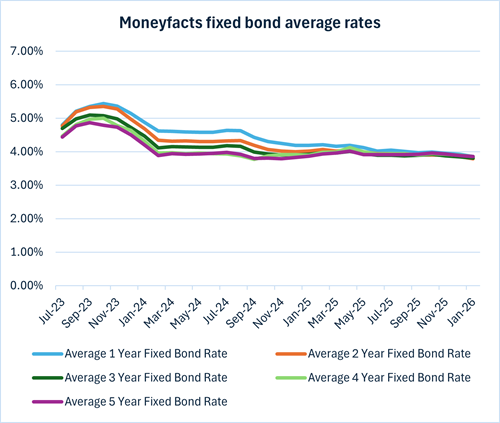
  • The average one-year fixed bond rate at 3.85% gross is now the same as the average five-year fixed bond at 3.85%. The rate gap was 0.04% a month prior.
  • In July 2025, the rate gap between the average one- and five-year bonds was 0.13%, as they sat at 4.04% and 3.91%, respectively.
  • A year ago, the average one-year bond paid 4.19%, while the average five-year bond paid 3.86%, a rate gap of 0.33%.


Savings market analysis – average fixed bond rates


Jul-23

Jan-24

Jul-24

Jan-25

Jul-25

Dec-25

Jan-26

Average one-year fixed bond rate

4.80%

4.87%

4.64%

4.19%

4.04%

3.92%

3.85%

Average two-year fixed bond rate

4.77%

4.68%

4.32%

4.02%

3.94%

3.85%

3.79%

Average three-year fixed bond rate

4.69%

4.46%

4.18%

3.92%

3.89%

3.84%

3.81%

Average four-year fixed bond rate

4.46%

4.31%

3.93%

3.89%

3.94%

3.89%

3.85%

Average five-year fixed bond rate

4.44%

4.20%

3.98%

3.86%

3.91%

3.88%

3.85%

Average interest rates based on a £10,000 deposit as at the start of the month.

Source: Moneyfactscompare.co.uk


Moneyfacts fixed bond average rates


Top fixed bonds

  • The top one- and two-year bonds fell, while the top three-, four- and five-year bonds remained unchanged.
  • The top one-year fixed bond fell to 4.46% gross, which is 0.18% lower than the top five-year fixed bond at 4.64%. The top five-year bond rate was higher than the top one-year bond a month prior by 0.14%.
  • In July 2025, the top one-year bond paid 4.55% and the top five-year paid 4.64%.
  • A year ago, the top one-year bond paid 4.79%, while the top five-year bond paid 4.64%, a gap of 0.15%.


Savings market analysis – top fixed bond rates


Jul-23

Jan-24

Jul-24

Jan-25

Jul-25

Dec-25

Jan-26

Top one-year fixed bond rate

6.02%

5.50%

5.25%

4.79%

4.55%

4.50%

4.46%

Top two-year fixed bond rate

6.10%

5.40%

5.13%

4.65%

4.45%

4.45%

4.24%

Top three-year fixed bond rate

6.10%

5.35%

4.85%

4.61%

4.45%

4.39%

4.39%

Top four-year fixed bond rate

5.75%

4.93%

4.60%

4.54%

4.54%

4.54%

4.54%

Top five-year fixed bond rate

5.70%

5.22%

4.95%

4.64%

4.64%

4.64%

4.64%

Top interest rates based on a £10,000 deposit as at the start of the month.

Source: Moneyfactscompare.co.uk


Moneyfacts top fixed bond rates


Average fixed bonds

  • The average one-year fixed bond rate at 3.85% gross is now the same as the average five-year fixed bond at 3.85%. The rate gap was 0.04% a month prior.
  • In July 2025, the rate gap between the average one- and five-year bonds was 0.13%, as they sat at 4.04% and 3.91%, respectively.
  • A year ago, the average one-year bond paid 4.19%, while the average five-year bond paid 3.86%, a rate gap of 0.33%.


Savings market analysis – average fixed bond rates


Jul-23

Jan-24

Jul-24

Jan-25

Jul-25

Dec-25

Jan-26

Average one-year fixed bond rate

4.80%

4.87%

4.64%

4.19%

4.04%

3.92%

3.85%

Average two-year fixed bond rate

4.77%

4.68%

4.32%

4.02%

3.94%

3.85%

3.79%

Average three-year fixed bond rate

4.69%

4.46%

4.18%

3.92%

3.89%

3.84%

3.81%

Average four-year fixed bond rate

4.46%

4.31%

3.93%

3.89%

3.94%

3.89%

3.85%

Average five-year fixed bond rate

4.44%

4.20%

3.98%

3.86%

3.91%

3.88%

3.85%

Average interest rates based on a £10,000 deposit as at the start of the month.

Source: Moneyfactscompare.co.uk


Moneyfacts fixed bond average rates


*Survey of 2,000 nationally representative UK adults carried out by OnePoll on behalf of Moneyfacts between 1 - 3 September 2025. Savings index data and analysis can be found here.

*Survey of 2,000 nationally representative UK adults carried out by OnePoll on behalf of Moneyfacts between 1 - 3 September 2025. Savings index data and analysis can be found here.

Notes to editors

You are welcome to use part or all of this press release, so long as we are sufficiently sourced. We would appreciate a link back to Moneyfactscompare.co.uk.

Pioneering financial comparison technology for over 35 years, Moneyfacts Group plc is the UK’s leading provider of retail financial product data. Used by virtually every bank and building society in the UK, and supplied to the Bank of England, Financial Conduct Authority, Financial Ombudsman Service, HM Treasury, Prudential Regulatory Authority and UK Finance.

Our expert research team monitors the thousands of mortgages, savings, credit card, personal loan, banking, life, pension and investment products in the UK.

Moneyfactscompare.co.uk is the financial product price comparison site, launched as Moneyfacts.co.uk in 2000 and rebranded to Moneyfactscompare.co.uk in 2023, which helps consumers compare thousands of financial products, including credit cards, savings, mortgages and many more. Unlike other comparison sites, Moneyfactscompare.co.uk shows whole of market data regardless of commercial bias, showing consumers a true picture of the best products based on the criteria they select.

For more information about us please see our key facts.

Broadcast

Our broadcast suite enables our finance experts to appear in-vision for television, and we regularly comment live on national and regional radio.

To arrange an interview for radio or television, please contact our press department. We have an in-house broadcast room.


 

Notes to editors

You are welcome to use part or all of this press release, so long as we are sufficiently sourced. We would appreciate a link back to Moneyfactscompare.co.uk.

Pioneering financial comparison technology for over 35 years, Moneyfacts Group plc is the UK’s leading provider of retail financial product data. Used by virtually every bank and building society in the UK, and supplied to the Bank of England, Financial Conduct Authority, Financial Ombudsman Service, HM Treasury, Prudential Regulatory Authority and UK Finance.

Our expert research team monitors the thousands of mortgages, savings, credit card, personal loan, banking, life, pension and investment products in the UK.

Moneyfactscompare.co.uk is the financial product price comparison site, launched as Moneyfacts.co.uk in 2000 and rebranded to Moneyfactscompare.co.uk in 2023, which helps consumers compare thousands of financial products, including credit cards, savings, mortgages and many more. Unlike other comparison sites, Moneyfactscompare.co.uk shows whole of market data regardless of commercial bias, showing consumers a true picture of the best products based on the criteria they select.

For more information about us please see our key facts.

Broadcast

Our broadcast suite enables our finance experts to appear in-vision for television, and we regularly comment live on national and regional radio.

To arrange an interview for radio or television, please contact our press department. We have an in-house broadcast room.

 

Contact Us If you're looking for extra comment, a chart or more information, then please give us a call. We are always more than happy to help.
Adam French Head of News & Communications
Rachel Springall Press Officer / Finance Expert
Caitlyn Eastell Press & PR Executive